The Ship: Construction and Naval Architecture
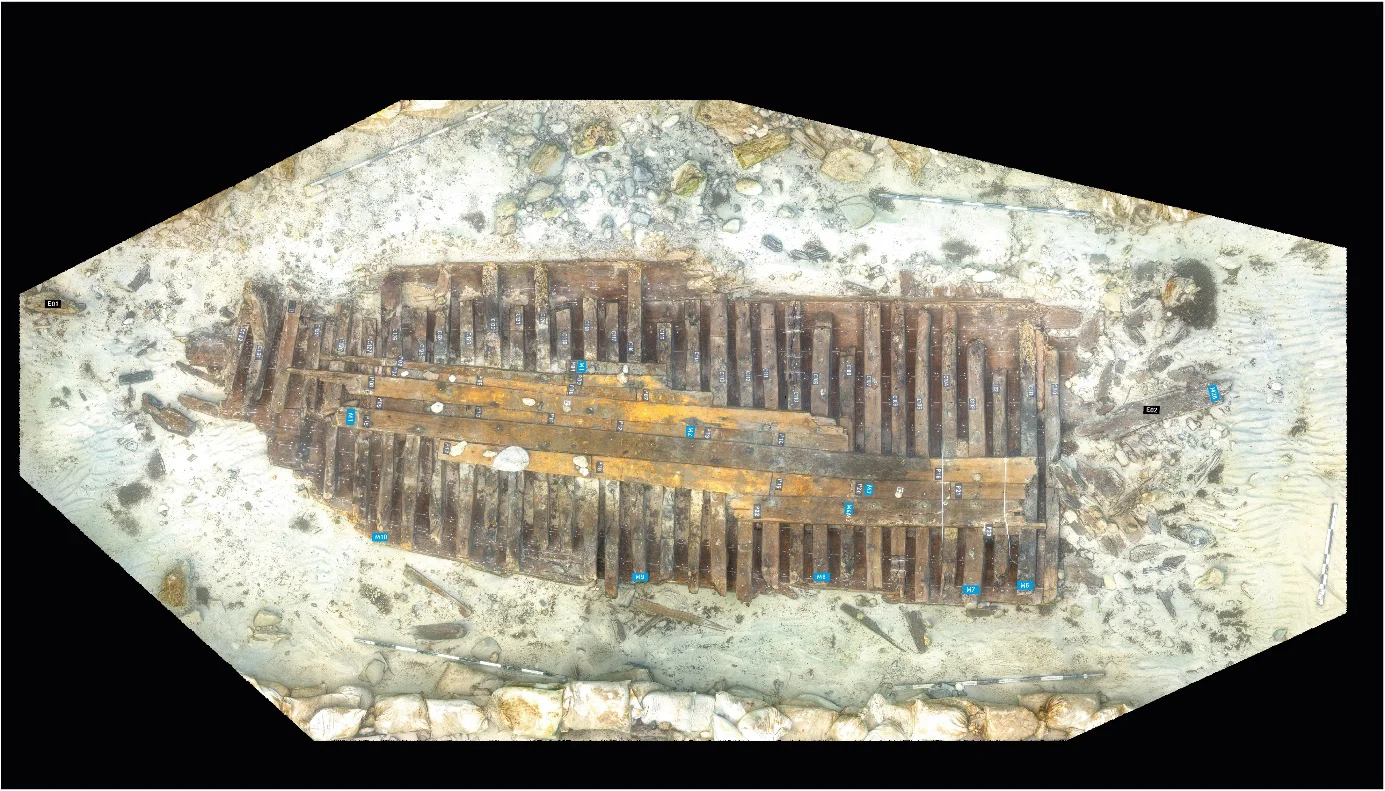
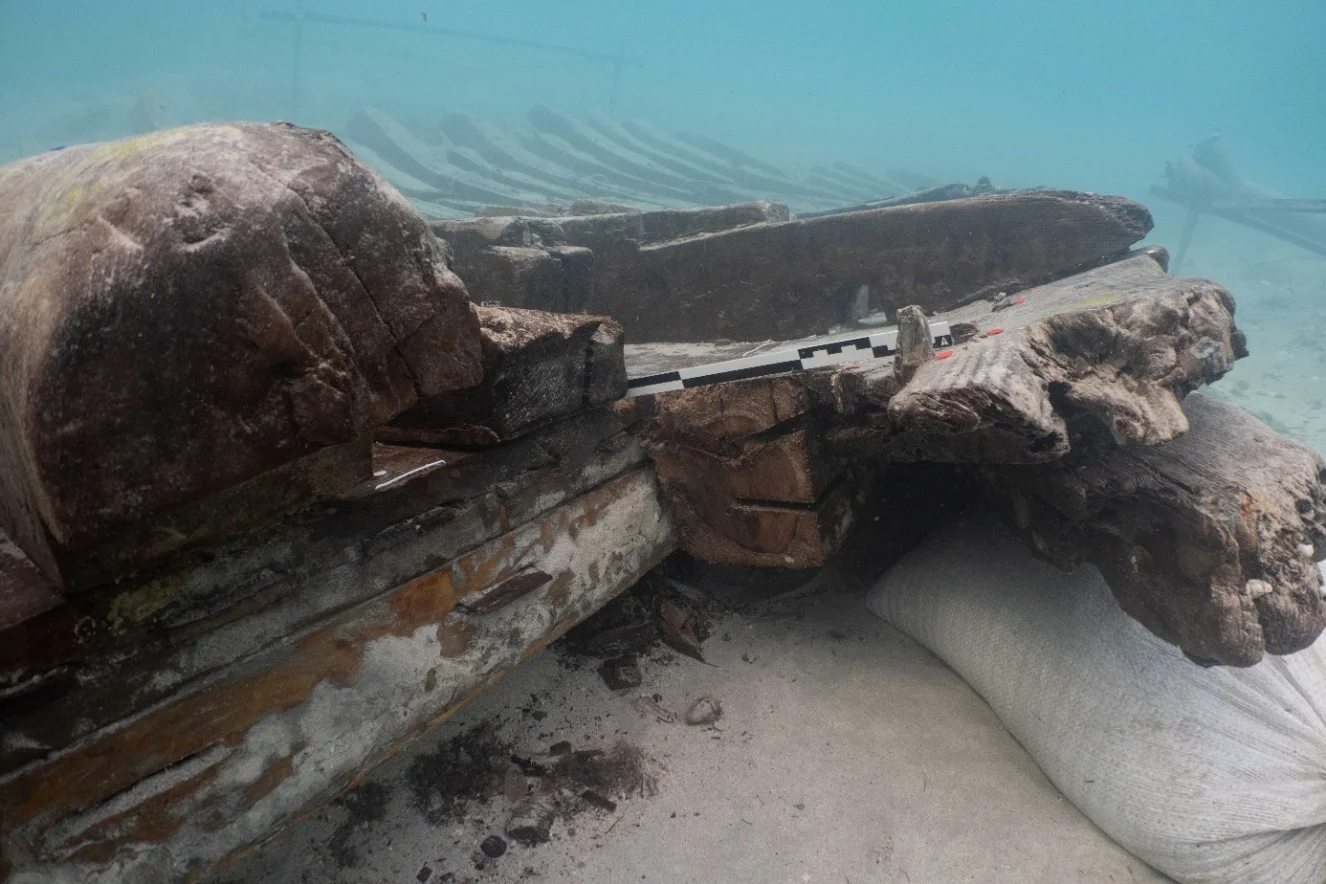
The wreck fragment is oriented east–west and is preserved over approximately 8.5 m in length and 3.35 m in width. It comprises 32 frames and 13 strakes and roughly corresponds to the forward quarter of the vessel (Figure 1).
The presence of a fore-foot and part of the stem indicates the proximity of an end that we believe is the bow (see below). The residual cargo dates the wreck to the second half of the first century AD, that is, a period marking the transition from a family of merchant ships popular throughout the Republican era, known as the “Hellenistic Hull Design,” to a new architectural type called the “Western Imperial Roman type,” which would predominate from the second century onward and throughout the Empire. The main architectural features of vessels of the latter type are: a flat-bottomed hull profile; a framing system consisting of alternating floor timbers and overlapping half-frames; and, finally, a keelson/mast-step timber fitted onto two lateral sister-keelsons.
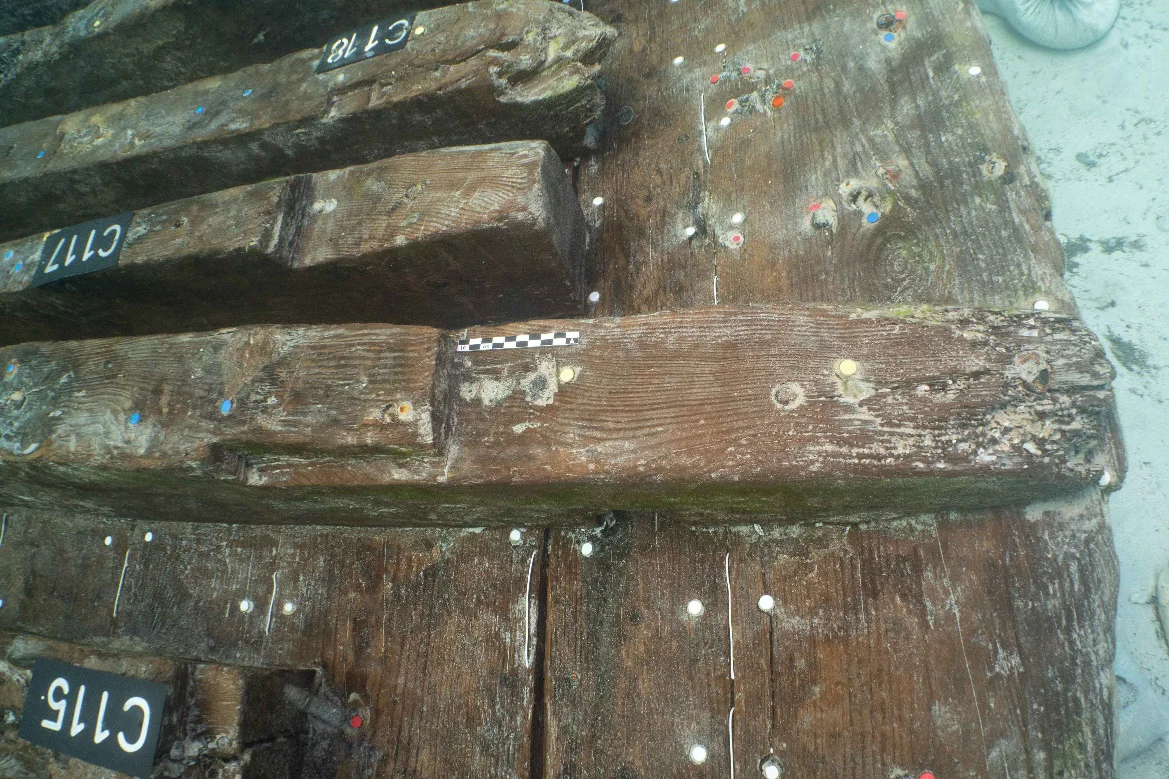
The hull form of the Ses Llumetes wreck clearly belongs to this flat-bottomed ship type, as opposed to the pinched-bottom hulls (with a wine-glass profile) of the preceding period. Nevertheless, it differs in certain respects. First, the half-frames are only very slightly overlapping: they join alternately on the port or starboard garboard strake, an observation made difficult by the absence of the opposite garboard over most of the wreck. Next, the assembly of the keelson/mast step timber to the keel, identified between C125 and C109, is unusual. Indeed, while the direct seating of the keelson onto the back of the floor timbers, without lateral sister-keelsons, recalls Republican-period practice, it differs in that the half-frames also display the rabbets required for this lapped joint, but in a different form. The half-frames bear a single rabbet running across the full width of the garboard (e.g., C117, Figure 2), whereas on the floor timbers the rabbet is double, with a lateral notch (e.g., C118 or C116). Comparative study is still ongoing.
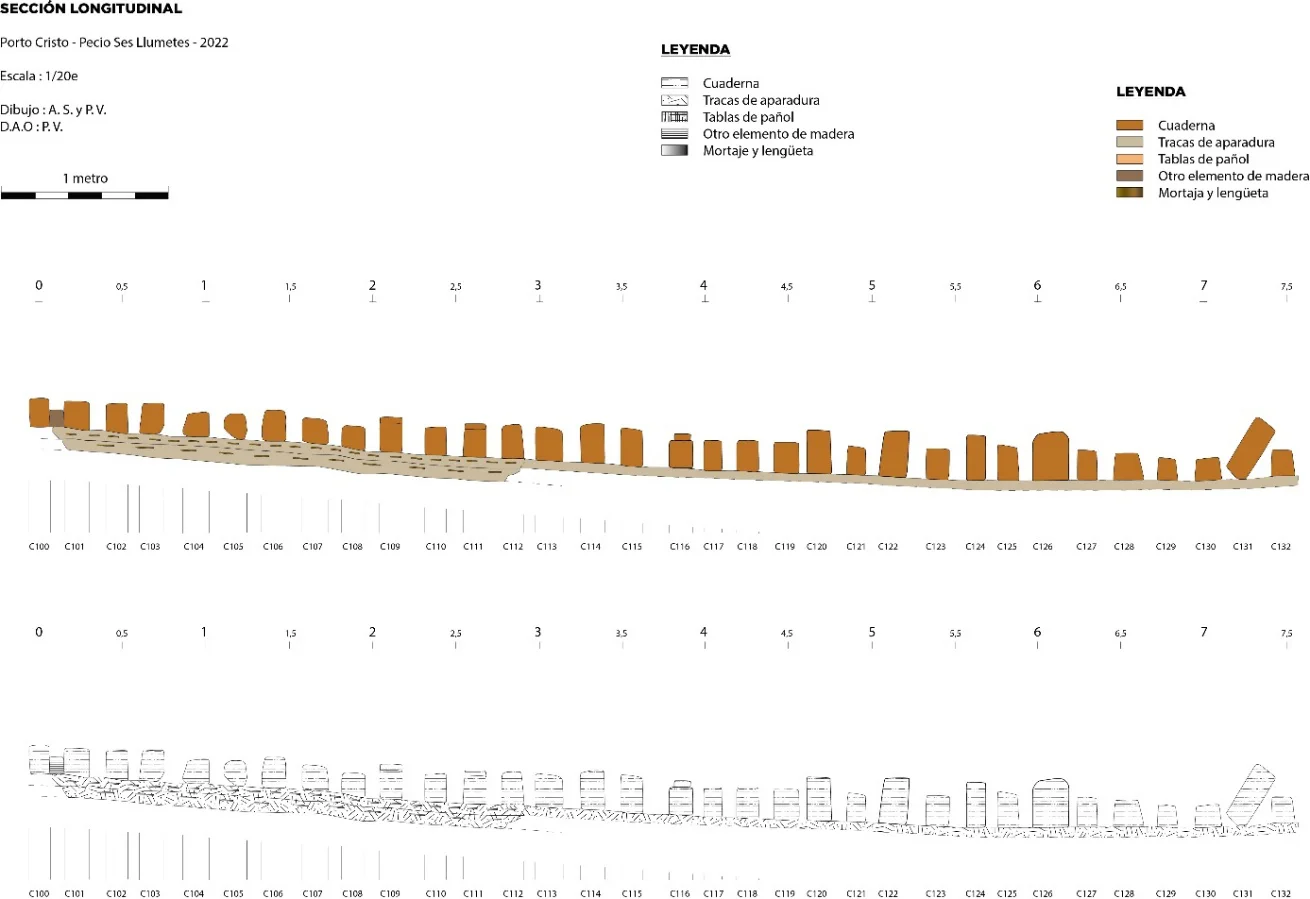
Another distinctive feature of the Ses Llumetes wreck is the presence of a double garboard. The hull is single-planked (single-skin); only the garboard strake is doubled (Figure 3 = longitudinal section; Figure 4 = view of the keel and the two superimposed garboards). Given the state of preservation, however, it could only be observed from the extremity up to floor timber C112, and we cannot assert that it continued beyond.
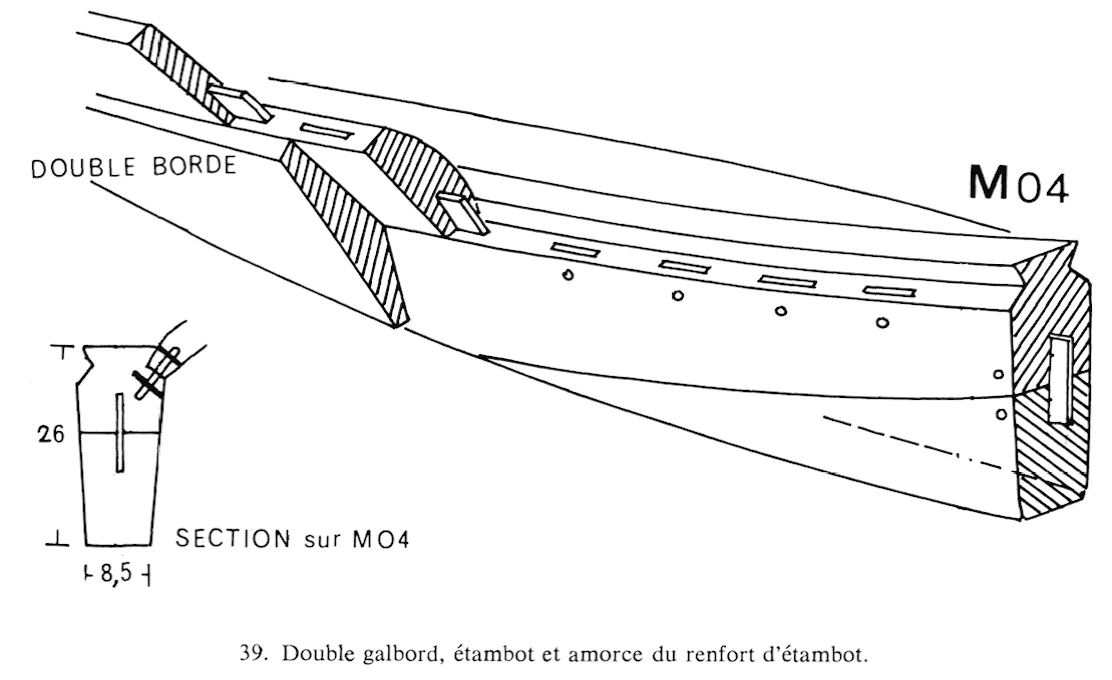
This feature is also found on the Bou Ferrer wreck, contemporary with Ses Llumetes, and likewise—though differently—on the Republican-period Cavalière wreck. On the latter, the double garboard is fitted over only 1.50 m from the preserved extremity, which corresponds to the stern (Figure 5 = Cavalière wreck). It overlies the side of the keel, the inner garboard, and very partially the beginning of the second strake.
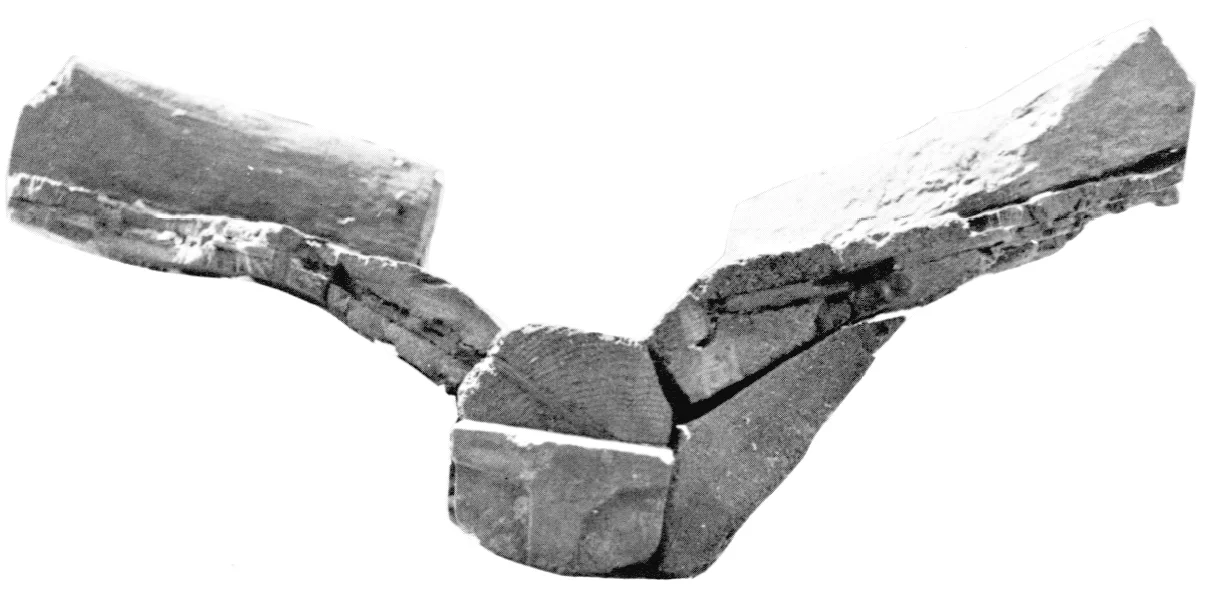
The wreck’s centerline is preserved only between frames C113 and C128, a length of 3.53 m. It consists of the keel and the beginning of the stem forefoot (keel: 2.94 m + forefoot: 0.59 m). The located Jupiter scarf, type of zig-zag joint used in ancient shipbuilding to connect two timbers and form a stronger, seamless structure capable of transferring tension and bending stress, links the keel and the forefoot between C124 and C126 (Figure 6). The entire area of the scarf, up to frame C128, is reinforced and protected, first by a thick layer of pitch applied directly to the keel, then by a wooden plate, and finally by a 0.5 cm–thick sheet of lead that covers the whole assembly. This is not a later repair, since the lead sheet was installed during construction: it is completely overlain by floor timbers C126 and C124.
A sample was taken from the keel, revealing novel information that requires comparative study with other wrecks, but already confirms a certain affinity with the Cavalière wreck and also with those from Marsala. Indeed, the underside of the keel shows two staggered mortises (at Marsala they are aligned), which must have housed vertical keys used to fasten an external keel reinforcement. These keys are pegged transversely (Figure 7). On the Cavalière wreck, this system (three mortises) allows the installation of a sternpost reinforcement (see supra, Fig. 5b).
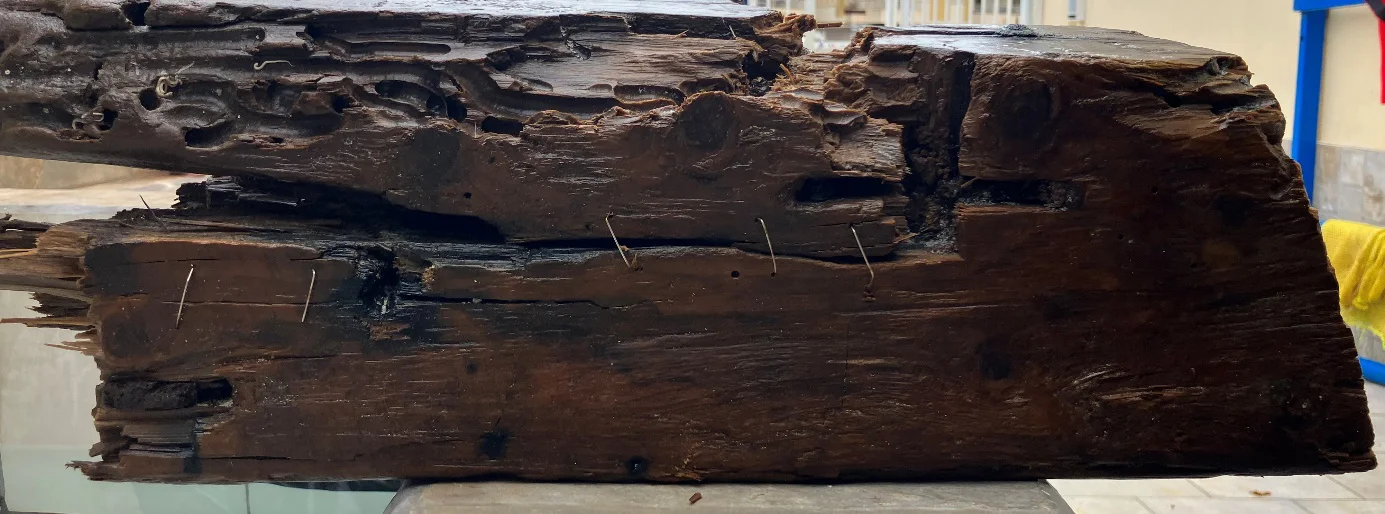
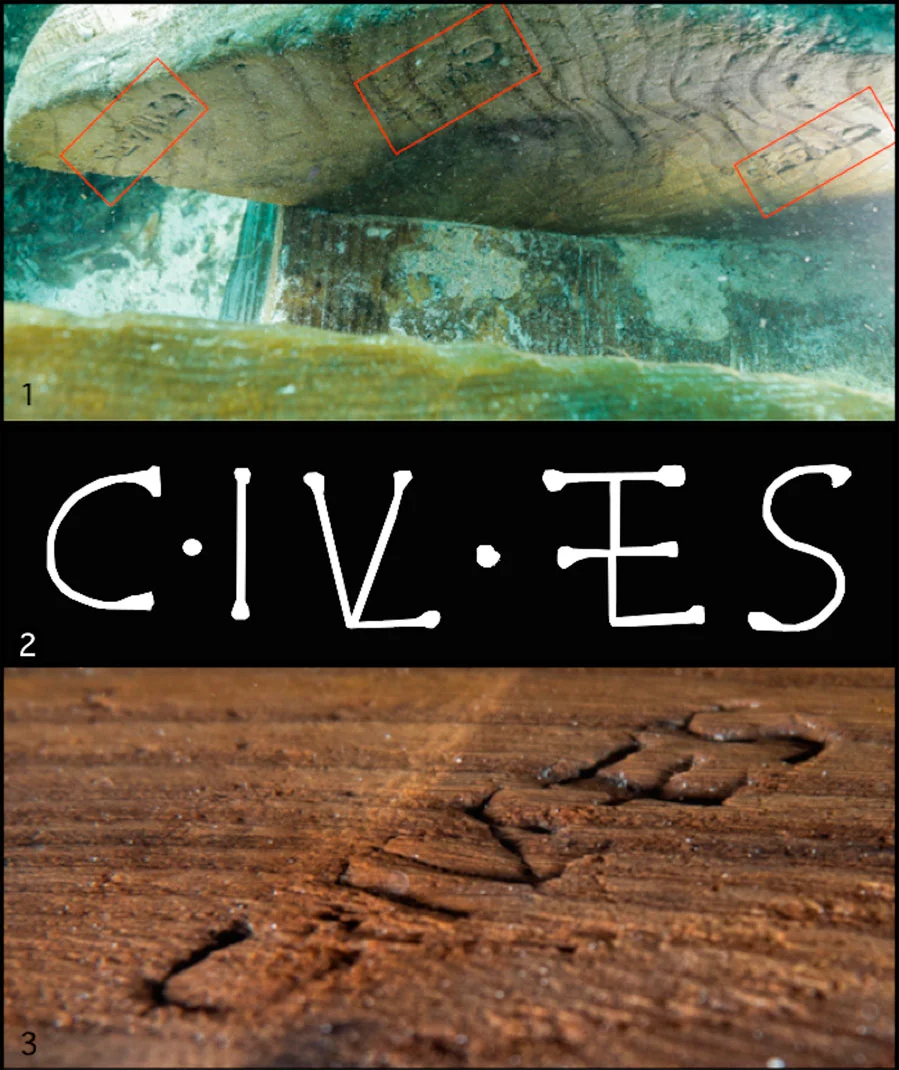
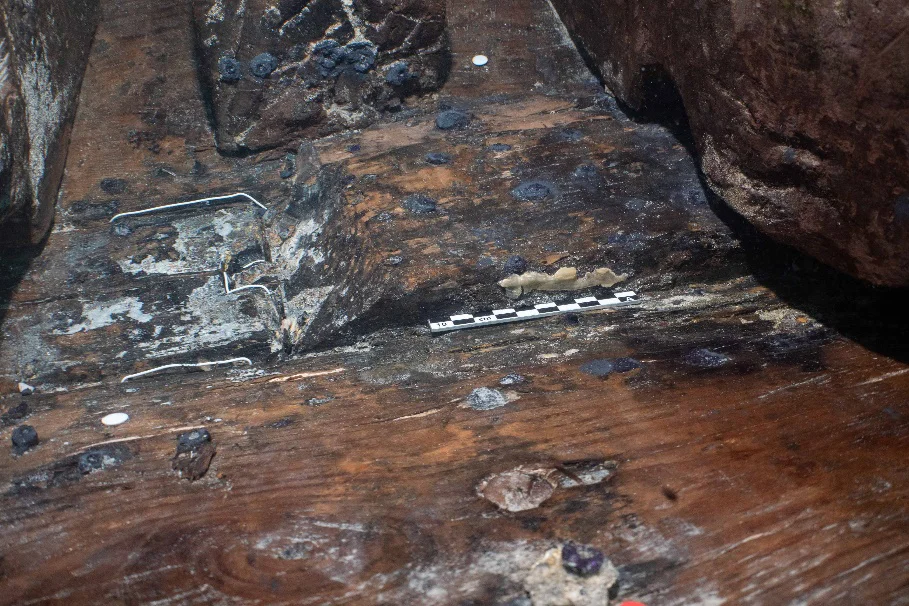
The height of this second keel is estimated at 10–12 cm (an approximation due to the thickness of the concretion), based on the length of a bolt concretion that fastened the keel to floor timber C124 at the level of the scarf. The total height of the keel would therefore be between 26 and 28 cm, subject to the caveat that this lower (false) keel is not merely a reinforcement related to the proximity of one end of the vessel, bow or stern. Several indications lead us, at this stage, to favor the bow. We observe that floor timbers C116 and C112 are the longest, as they do not terminate before the turn of the bilge (respectively T12 and T10/T11), whereas the other floor timbers join their respective futtocks around strakes T7/T8. Although it is not possible to affirm that C113 is a floor timber (it may be an overlapping half-frame), given its state of preservation at the keel, we note that this frame bears the inscription C•I(VL)•(TELE)S (Figure 8).
Assuming the mast-step socket lies between C116 and C112, the distance between the preserved end of the hull at C132 and the mast would be 5 m. Given that the main mast of a Roman ship is located in the forward third of the vessel and that the shape of C131 indicates the upward sweep of the hull toward the stem is already well advanced (beginning shortly after the forefoot), we can project an additional length of 10 m toward the stern. Taking the forward and aft overhangs into account, the length of the Ses Llumetes vessel should be estimated at, at most, around twenty meters. With a keel height of 26–28 cm, this vessel was well suited to coastal navigation in shallow waters or estuarine sailing, though its operating range may well have extended to the open sea.
If we move now beyond the naval architecture of the ship (how the ship was built) and explore who build it and where. The strongest clue to the ship’s place of construction and the people behind it is a maker’s stamp burned four times into the west face of frame C-111: C•I(VL)•(TELE)S. This is likely as an abbreviated tria nomina —C(aius) Iul(ius) Teles(…)—applied with a hot signaculum (metallic stamp). Its hidden placement and repeated use point to a professional shipwright’s or yard mark rather than decoration or ownership mark. Epigraphic parallels make Telesphorus the most likely expansion of “Teles(…)”, a cognomen especially common in the regions of Lazio–Campania, with multiple attestations at Ostia (including a 1st-century inscription for a C. Iulius Telesphorus, domo Ravenna). It seems quite likely that this individual could have been a marine carpenter connected to a yard at Ostia/Ravenna. Therefore, is quite certain to argue that the hull of the Ses Llumetes ship was probably built in the Italic Peninsula, very likely somewhere in the Ostia–Lazio–Campania corridor; although this hypothesis is still awaiting confirmation.